
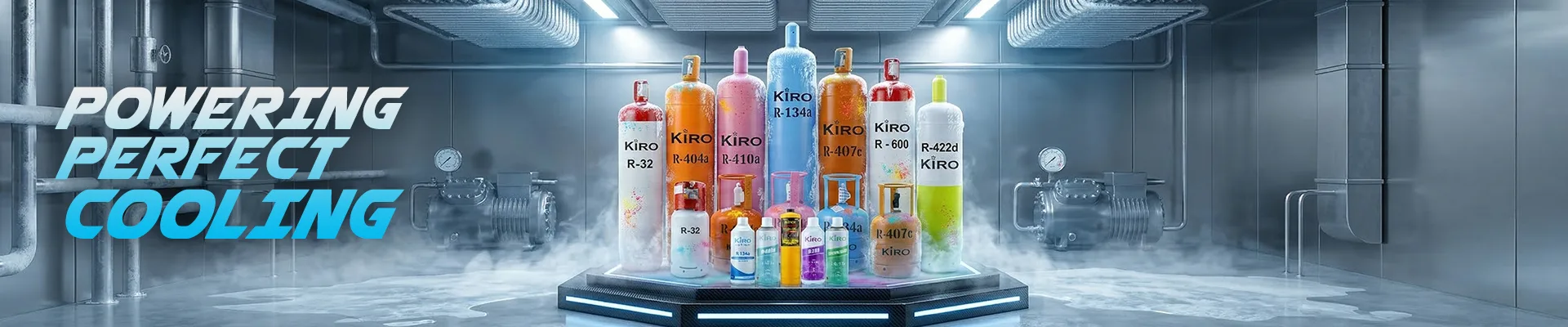
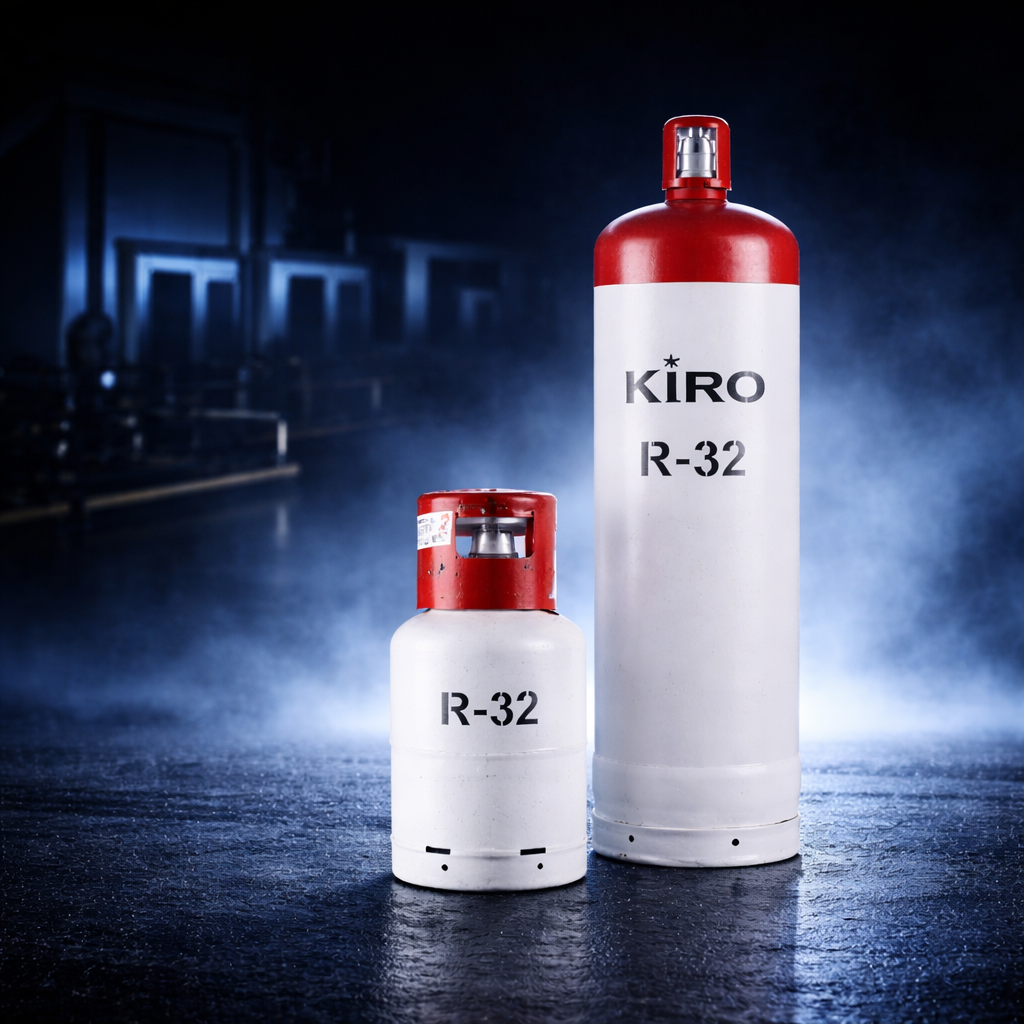
R32
Packaging- 8Kgs/45Kgs
Difluoromethane
Oil : Polyolester – Slightly Flammable
Application – Commercial and Domestic Air Conditioning Replacement for R410A, R22
| HAZARDS IDENTIFICATION - Emergency | |
|---|---|
| Overview | |
| Form | Liquefied gas |
| Color | Colorless |
| Odor | Slight sweet ether-like |
| Hazard Summary | Warning! Container under pressure. Flammable. Gas reduces oxygen available for breathing. Causes asphyxiation in high concentrations. The victim will not realize that he/she is suffocating. Inhalation may cause central nervous system effects. May cause cardiac arrhythmia. May cause drowsiness and dizziness. Do not breathe vapour. Irritating to eyes and skin. Avoid contact with skin, eyes and clothing. At higher temperatures (>250°C), decomposition products may include hydrofluoric acid (HF) and carbonyl halides. The ACGIH Threshold Limit Values (2007) for Hydrogen Fluoride are TLV/TWA 0.5 ppm and Ceiling Exposure Limit 2 ppm. |
| Potential Health Effects | |
| Skin | Avoid skin contact with leaking liquid (danger of frostbite). May cause frostbite. Irritating to skin. |
| Eyes | Causes serious eye irritation. May cause frostbite. |
| Ingestion |
Unlikely route of exposure. Effects due to ingestion may include: Gastrointestinal discomfort |
| Inhalation |
Gas reduces oxygen available for breathing. Causes asphyxiation in high concentrations. The victim will not realize that he/she is suffocating. Inhalation may cause central nervous system effects. May cause cardiac arrhythmia. Vapours may cause drowsiness and dizziness. |
| Chronic Exposure | None known. |
| Carcinogenicity | |
| No component of this product present at levels greater than or equal to 0.1% is identified as a known or anticipated carcinogen by NTP, IARC, or OSHA. | |
| COMPOSITION / INFORMATION ON INGREDIENTS | ||
|---|---|---|
| Component | CAS-No. | Weight percent |
| Difluoromethane | 75-10-5 | 100.00 |
| FIRST AID MEASURES | |
|---|---|
| Inhalation | Move to fresh air. If breathing is irregular or stopped, administer artificial respiration. Use oxygen as required, provided a qualified operator is present. Call a physician. Do not give drugs from adrenaline-ephedrine group. |
| Skin contact | After contact with skin, wash immediately with plenty of water. If there is evidence of frostbite, bathe (do not rub) with lukewarm (not hot) water. If water is not available, cover with a clean, soft cloth or similar covering. If symptoms persist, call a physician. |
| Eye contact | Remove contact lenses. Rinse immediately with plenty of water, also under the eyelids, for at least 15 minutes. |
| Ingestion | Unlikely route of exposure. As this product is a gas, refer to the inhalation section. Do not induce vomiting without medical advice. Call a physician immediately. |
| Notes to physician | |
| Treatment | Because of the possible disturbances of cardiac rhythm, catecholamine drugs, such as epinephrine, should be used with special caution and only in situations of emergency life support. Treatment of overexposure should be directed at the control of symptoms and the clinical conditions. Treat frostbitten areas as needed. |
| Treatment | Do not give adrenaline or similar drugs. |
| FIRE-FIGHTING MEASURES | |
|---|---|
| Flash point | Not applicable |
| Ignition temperature | >750 °C (1,382 °F) |
| Lower explosion limit | 14.4 %(V) |
| Upper explosion limit | 33.4 %(V) |
| Suitable extinguishing media |
Use water spray, alcohol-resistant foam, dry chemical or carbon dioxide. Use extinguishing measures that are appropriate to local circumstances and the surrounding environment. |
| Specific hazards during fire |
Contents under pressure. Flammable. Flash back possible over considerable distance. Container may rupture on heating. Cool closed containers exposed to fire with water spray. Do not allow run-off from fire fighting to enter drains or water courses. Vapours are heavier than air and can cause suffocation by reducing oxygen available for breathing. Rapid evaporation of the liquid may cause frostbite. In case of fire hazardous decomposition products may be produced such as: Hydrogen fluoride Carbon monoxide Carbon dioxide (CO2) Carbonyl halides |
| Special protective equipment for fire-fighters |
In the event of fire and/or explosion do not breathe fumes. Wear self-contained breathing apparatus and protective suit. No unprotected exposed skin areas. |
| ACCIDENTAL RELEASE MEASURES | |
|---|---|
| Personal precautions |
Immediately evacuate personnel to safe areas. Keep people away from and upwind of spill/leak. Wear personal protective equipment. Unprotected persons must be kept away. Remove all sources of ignition. Avoid skin contact with leaking liquid (danger of frostbite). Ventilate the area. After release, disperses into the air. Vapours are heavier than air and can cause suffocation by reducing oxygen available for breathing. Avoid accumulation of vapours in low areas. Unprotected personnel should not return until air has been tested and determined safe. Ensure that the oxygen content is >= 19.5 %. |
| Environmental precautions |
Prevent further leakage or spillage if safe to do so. The product evaporates readily. |
| Methods for cleaning up | Ventilate the area. |
| HANDLING AND STORAGE | |
|---|---|
| Handling |
Handle with care. Avoid inhalation of vapour or mist. Do not get in eyes, on skin, or on clothing. Wear personal protective equipment. Use only in well-ventilated areas. Pressurized container. Protect from sunlight and do not expose to temperatures exceeding 50 °C. Keep away from heat/sparks/open flames/hot surfaces. - No smoking. Follow all standard safety precautions for handling and use of compressed gas cylinders. Protect cylinders from physical damage. Do not puncture or drop cylinders, expose them to open flame or excessive heat. Do not pierce or burn, even after use. Do not spray on a naked flame or any incandescent material. Do not remove screw cap until immediately ready for use. Always replace cap after use. |
| Handling |
Open drum carefully as content may be under pressure. The product should only be used in areas from which all naked lights and other sources of ignition have been excluded. Pressurized container. Protect from sunlight and do not expose to temperatures exceeding 50 °C. Do not pierce or burn, even after use. Do not spray on a naked flame or any incandescent material. Do not use in areas without adequate ventilation. Contaminated equipment (brushes, rags) must be cleaned immediately with water. |
| Advice on protection against fire and explosion |
Vapours may form explosive mixture with air. Container hazardous when empty. Keep product and empty container away from heat and sources of ignition. The heavy vapours can overcome a considerable distance up to the source of ignition. Take measures to prevent the build up of electrostatic charge. Electrical equipment should be protected to the appropriate standard. |
| Storage | |
| Requirements for storage and containers place |
Keep containers tightly closed in a dry, cool and well-ventilated areas. Pressurized container: Protect from sunlight and do not expose to temperatures exceeding 50 °C. Do not pierce or burn, even after use. Keep away from heat and sources of ignition. Protect cylinders from physical damage. Store away from incompatible substances. Storage rooms must be properly ventilated. Ensure adequate ventilation, especially in confined areas. |
| Further information on storage conditions |
Store in original container. Keep containers tightly closed in a cool, well-ventilated place. Keep away from direct sunlight. |
| EXPOSURE CONTROLS / PERSONAL PROTECTION | |
|---|---|
| Protective measures |
Do not breathe vapour. Avoid contact with skin, eyes and clothing. Ensure that eyewash stations and safety showers are close to the workstation location. |
| Engineering measures |
General room ventilation is adequate for storage and handling. Perform filling operations only at stations with exhaust ventilation facilities. |
| Eye protection |
Do not wear contact lenses. Wear as appropriate: Safety glasses with side-shields. If splashes are likely to occur, wear goggles or face shield, giving complete protection to eyes. |
| Hand protection |
Leather gloves. In case of contact through splashing: Protective gloves – Neoprene gloves. Polyvinyl alcohol or nitrile-butyl-rubber gloves. |
| Skin and body protection |
Avoid skin contact with leaking liquid (danger of frostbite). Wear cold insulating gloves/face shield/eye protection. |
| Respiratory protection |
In case of insufficient ventilation wear suitable respiratory equipment. Wear a positive-pressure supplied-air respirator. Vapours are heavier than air and can cause suffocation by reducing oxygen available for breathing. For rescue and maintenance work in storage tanks use self-contained breathing apparatus. |
| Hygiene measures |
Handle in accordance with good industrial hygiene and safety practice. Ensure adequate ventilation, especially in confined areas. Avoid contact with skin, eyes and clothing. Remove and wash contaminated clothing before re-use. Keep working clothes separately. |
| Exposure Guidelines | |
| Difluoromethane | CAS-No: 75-10-5 | WEEL TWA: 1,000 ppm (2,200 mg/m³) |
| PHYSICAL AND CHEMICAL PROPERTIES | |
|---|---|
| Form | Liquefied gas |
| Color | Colorless |
| Odor | Slight sweet ether-like |
| Molecular Weight | 52 g/mol |
| pH | Neutral |
| Freezing point | -136 °C (-213 °F) |
| Boiling point / boiling range | -51.7 °C (-61.1 °F) |
| Vapor pressure | 15,189 hPa at 21.1 °C (70.0 °F) |
| Vapor pressure | 34,804 hPa at 54.4 °C (129.9 °F) |
| Relative vapour density | 1.8 (Air = 1.0) |
| Density | 1.002 g/cm³ at 26.7 °C (80.1 °F) |
| Water solubility | Insoluble |
| Partition coefficient: n-octanol/water | log Pow: 0.21 |
| STABILITY AND REACTIVITY | |
|---|---|
| Conditions to avoid |
Protect from heat/overheating. Decomposes under high temperature. Contains gas under pressure; may explode if heated. Keep away from heat/sparks/open flames/hot surfaces. - No smoking. Keep away from direct sunlight. Some risk may be expected of corrosive and toxic decomposition products. |
| Materials to avoid |
Finely divided aluminium Potassium Calcium Powdered metals Aluminium Magnesium Zinc |
| Hazardous decomposition products |
Halogenated compounds Hydrogen fluoride Carbonyl halides Carbon oxides |
| Thermal decomposition |
>250 °C To avoid thermal decomposition, do not overheat. |
| Hazardous reactions |
Hazardous polymerisation does not occur. Stable under normal conditions. |
| TOXICOLOGICAL INFORMATION | |
|---|---|
| Acute inhalation toxicity |
LC50 rat Dose: > 520000 ppm Exposure time: 4 h |
| Sensitisation |
Cardiac sensitization (dogs) No-observed-effect level >350,000 ppm |
| Repeated dose toxicity |
Inhalation rat Subchronic toxicity NOEL: 50,000 ppm |
| Genotoxicity in vitro | Ames test: negative |
| Genotoxicity in vitro |
Human lymphocytes: negative Mutagenicity (in vitro mammalian cytogenetic test) |
| Genotoxicity in vitro | Chromosome aberration test in vitro: negative |
| Genotoxicity in vivo |
Species: mouse Cell type: Bone marrow Mutagenicity (micronucleus test): negative |
| Teratogenicity | Rat – NOEL: 50,000 ppm |
| Teratogenicity | Rabbit – NOEL: 50,000 ppm |
| ECOLOGICAL INFORMATION | |
|---|---|
| Biodegradability | Minimal |
| Additional ecological information |
This product contains greenhouse gases which may contribute to global warming. Do NOT vent to the atmosphere. |
| DISPOSAL CONSIDERATIONS | |
|---|---|
| Waste Information | Observe State, Federal, and Local Environmental regulations. |
| TRANSPORT INFORMATION | |
|---|---|
| DOT | |
| UN-Number | 3252 |
| Proper shipping name | DIFLUOROMETHANE |
| Class | 2.1 |
| Packing group | - |
| Hazard Labels | 2.1 |
| IATA | |
| UN Number | 3252 |
| Description of the goods | DIFLUOROMETHANE |
| Class | 2.1 |
| Hazard Labels | 2.1 |
| Packing instruction (cargo aircraft) | 200 |
| IMDG | |
| Substance No | UN 3252 |
| Description of the goods | DIFLUOROMETHANE |
| Class | 2.1 |
| Hazard Labels | 2.1 |
| EmS Number | F-D |
| Marine pollutant | No |
| REGULATORY INFORMATION | |
|---|---|
| Inventories | |
| 1907/2006 (EU) | This mixture contains only ingredients which have been subject to a pre-registration according to Regulation (EC) No. 1907/2006 (REACH). |
| US Toxic Substances | On TSCA Inventory |
| Australia Industrial | On the inventory, or in compliance with the inventory Chemical Control Act (Industrial Chemicals Assessment Act). |
| Canada |
All components of this product are on the Canadian DSL list. Environmental Protection Act (CEPA), Domestic Substances List (DSL). (Can. Gaz. Part II, Vol. 133) |
| Japan Kashin-Hou Law | On the inventory, or in compliance with the inventory list. |
| Korea Toxic Chemical Law (TCCL) | On the inventory, or in compliance with the inventory Control Law list. |
| Philippines | On the inventory, or in compliance with the inventory Substances and Hazardous and Nuclear Waste Control Act. |
| China Inventory of Existing Substances | On the inventory, or in compliance with the inventory Chemical Control Act. |
| New Zealand |
Inventory of Chemicals (NZIoC), as published by ERMA New Zealand. On the inventory, or in compliance with the inventory. |
| National regulatory information | |
| Hazards |
Fire Hazard Acute Health Hazard Sudden Release of Pressure Hazard |
| CAS Number | Dichloromethane – 75-09-2 |
| California Proposition 65 |
WARNING! This product contains a chemical known in the State of California
to cause birth defects or other reproductive harm. Chloromethane (CAS: 74-87-3) |
| WHMIS Classification |
A This product has been classified according to the hazard criteria of the CPR and the MSDS contains all of the information required by the CPR. |
| Global warming potential | 550 |
| OTHER INFORMATION | ||
|---|---|---|
| HMIS III | NFPA | |
| Health hazard | 1 | 2 |
| Flammability | 4 | 4 |
| Physical Hazard | 0 | - |
| Instability | 0 | - |